
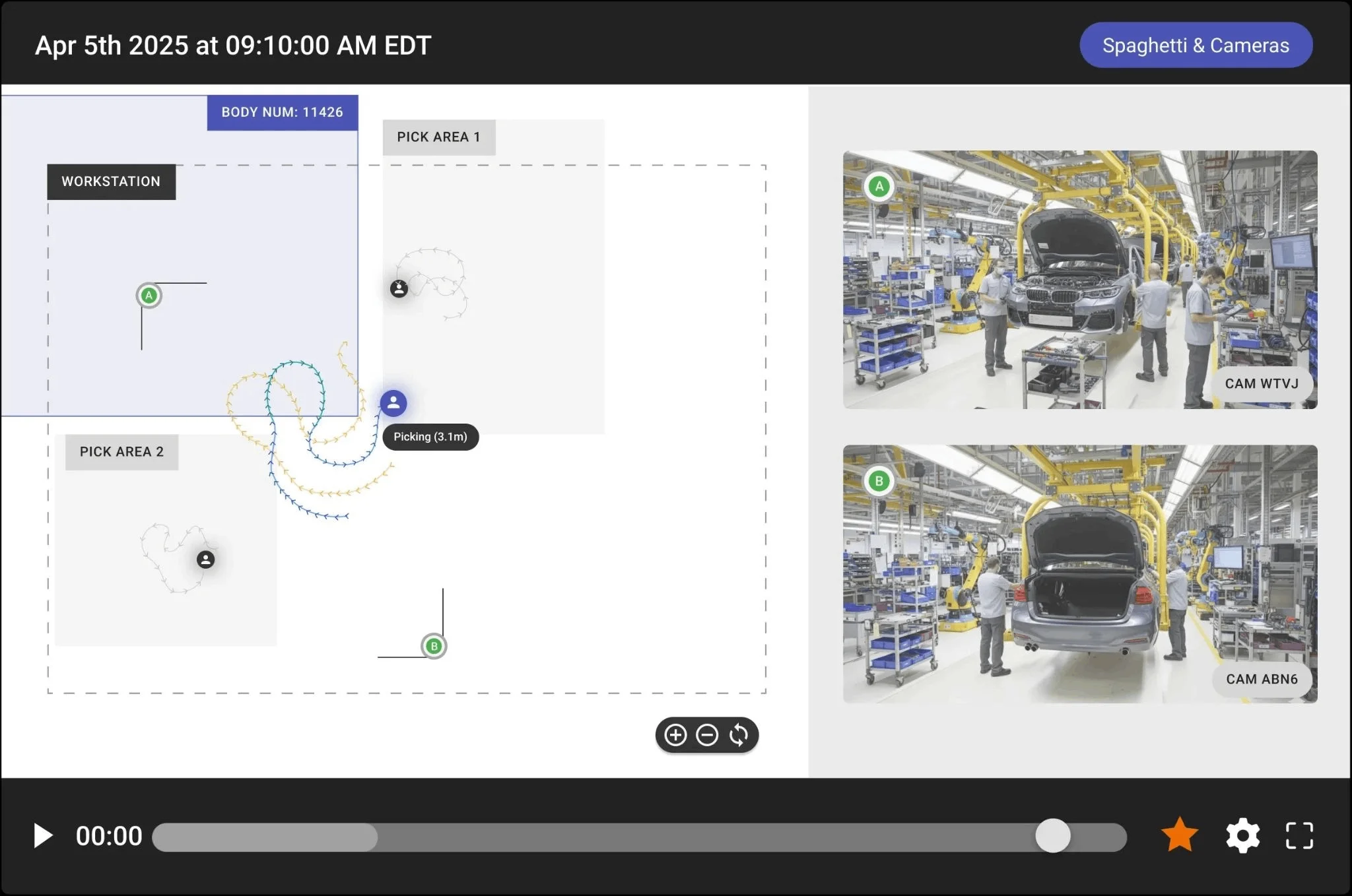
Cameras have watched manufacturing floors for decades, but until recently, most of that footage went almost entirely unused, reviewed only after an incident, if at all, and otherwise sitting idle in storage. Video analytics for manufacturing changes that equation completely, applying computer vision and machine learning to live camera feeds so that footage becomes a continuous, structured source of operational intelligence rather than a passive security record.
Invisible AI is built around exactly this capability: turning manufacturing video into real-time, actionable insight. This page explains what video analytics for manufacturing involves, why it represents such a significant shift from traditional floor monitoring approaches, the core technical capabilities that make it work, and how Invisible AI applies video analytics across the areas that matter most to manufacturing performance.
What Is Video Analytics for Manufacturing, and Why Does It Outperform Traditional Monitoring?
Video analytics for manufacturing refers to the use of computer vision and artificial intelligence to automatically analyze camera footage from the production floor, extracting structured, meaningful data, such as downtime events, quality defects, safety behaviors, and process deviations without requiring a person to manually watch or review the footage. Rather than treating video as a passive record to be pulled up only after something has already gone wrong, video analytics actively interprets what’s happening in real time, converting raw footage into data that operations, quality, and safety teams can act on immediately.
This represents a meaningful shift from how manufacturing video has traditionally been used. In most plants, camera footage has served a narrow security or compliance function, stored for weeks, reviewed rarely, and valuable mainly as evidence after an incident has already occurred. That approach leaves an enormous amount of operational insight sitting unused, since the footage already contains rich information about line performance, process consistency, and floor conditions that traditional systems simply never extract.
Video analytics for manufacturing unlocks that latent value in several concrete ways:
- Automatic event detection, identifying downtime, quality issues, and safety-relevant behaviors directly from live video, without manual monitoring
- Objective, consistent measurement, since the same detection logic applies uniformly across every shift, line, and plant rather than depending on individual observer judgment
- Rich contextual evidence, giving teams actual visual context for an event rather than a secondhand description or an isolated data point
- Retroactive and real-time value, supporting both live alerting and after-the-fact analysis from the same underlying video infrastructure
- Efficient use of existing camera investment, extracting far more value from cameras that many plants have already installed for security purposes
As manufacturers look for ways to improve visibility without adding extensive new sensor infrastructure at every station, video analytics for manufacturing has emerged as one of the most practical and scalable paths to comprehensive floor intelligence, turning an underused asset into one of the most valuable data sources in the plant.
Manufacturers have several options for gathering floor data: manual observation, point sensors on individual machines, and increasingly, video-based analytics. Understanding why video-based approaches have gained so much traction requires looking at what they capture that other methods typically miss.
Manual observation, whether through supervisor walkthroughs or dedicated time studies, is inherently limited by human bandwidth. A person can only watch one location at a time, for a limited portion of the shift, and their observations are shaped by attention, fatigue, and subjective judgment. Video analytics removes these constraints entirely, providing continuous, consistent observation across every monitored location, for the full duration of every shift, without the natural variability that comes from human attention span.
Point sensors, the kind commonly used in traditional machine monitoring, solve part of the visibility problem by capturing precise, machine-level signals like cycle counts or fault codes. But they’re inherently narrow: a sensor on a specific machine tells you what that machine did, not why, and it typically has nothing to say about the human actions, workflow context, or upstream conditions that often explain the root cause of an issue. Video analytics captures the full scene, which means it can connect a machine event to the broader context surrounding it, an operator action, a material handling issue, or an upstream process change in a way that a single-point sensor never could.
Video analytics also has a unique advantage in how it supports investigation and validation. When a downtime event, quality defect, or safety observation is flagged, teams aren’t just looking at a data point; they can review the actual footage tied to that event, confirming exactly what happened rather than relying on interpretation or memory. This dramatically increases confidence in the data and shortens the time needed to reach an accurate root cause.
Finally, video analytics scales more efficiently than either manual observation or extensive point-sensor deployment. Adding new sensors to every station across a large facility, or across multiple facilities, represents significant hardware and integration cost. Video analytics, by contrast, can extend detection capability to new use cases largely through software, often using camera infrastructure that’s already in place, which makes it a substantially more scalable path to comprehensive floor visibility.
Core Technical Capabilities Behind Manufacturing Video Analytics
Delivering reliable, production-grade video analytics for manufacturing requires a specific combination of computer vision, machine learning, and infrastructure capabilities working together.
Purpose-trained detection models: Generic video analysis isn’t sufficient for manufacturing use cases; models have to be specifically trained to recognize the events that matter on a production floor, such as line stoppages, specific defect types, or at-risk safety behaviors, often tailored to the particular processes and equipment found in a given facility or industry.
Real-time processing at scale: To deliver actionable insight rather than delayed reporting, video analytics platforms need the processing infrastructure to analyze multiple live video streams simultaneously, across many lines and plants, without meaningful lag between an event occurring and it being detected and reported.
Structured data extraction: Raw detection isn’t useful on its own; the platform needs to translate what it observes into structured, categorized data that can be searched, trended, and reported on, connecting each detected event to relevant metadata like time, location, line, and event type.
Footage-linked evidence: Because visual context is one of the biggest advantages video analytics offers, effective platforms preserve and link the relevant footage to each detected event, allowing teams to review exactly what happened rather than relying solely on a summary data point.
Flexible deployment across varied environments: Manufacturing floors vary widely in layout, lighting, and equipment, so video analytics platforms have to be adaptable enough to perform reliably across genuinely different environments, rather than requiring a narrowly controlled setting to function accurately.
Privacy-conscious design: Because this technology observes an environment where people are working, responsible platforms are built with clear, deliberate boundaries around what is analyzed and how data is used, focused specifically on operational and safety insight rather than individual employee tracking or surveillance.
Invisible AI’s platform is engineered around this full set of capabilities, which is what allows video analytics for manufacturing to move beyond a novelty use case and function as a dependable, everyday operational tool across the plant floor.
How Invisible AI Applies Video Analytics Across the Plant
Invisible AI applies video analytics for manufacturing across the core functions that determine plant performance, using the same underlying camera-based platform to serve multiple teams and use cases at once.
In safety and ergonomics, video analytics identifies at-risk behaviors and ergonomic strain patterns as they occur, giving safety teams the visual evidence they need to intervene early and reduce injury risk across the floor.
For quality management, the same video infrastructure detects defects and process deviations with full visual context, helping quality teams move from reactive inspection to proactive, root-cause-driven correction.
Our production management capabilities use video analytics to track downtime, throughput, and line performance in real time, giving plant managers a comprehensive, accurate operational picture without relying on manual logs.
That same data stream directly supports continuous improvement initiatives, giving teams the ongoing, footage-backed evidence base they need to test process changes and confirm that improvements actually hold up over time.
Invisible AI’s video analytics platform is deployed across demanding manufacturing sectors, including automotive production, where high line speeds require fast, reliable detection, and aerospace manufacturing, where precision, documentation, and traceability requirements are especially rigorous.
Across each of these applications, Invisible AI’s video analytics for manufacturing turns existing camera infrastructure into one of the most valuable and versatile data sources on the entire production floor.
Frequently Asked Questions: Video Analytics for Manufacturing
What kinds of events can video analytics detect on a manufacturing floor? Common use cases include downtime and line stoppages, quality defects and process deviations, at-risk safety behaviors, and ergonomic strain patterns, all detected automatically from video without requiring manual review or observation.
Does video analytics for manufacturing require installing new cameras? Not necessarily. Many platforms are designed to work with existing camera infrastructure already in place for security or general monitoring purposes, extending its value into operational analytics without requiring a full new hardware deployment.
How is video analytics different from traditional machine sensors? Machine sensors typically capture narrow, point-level signals about a specific piece of equipment. Video analytics observes the broader scene, capturing operator actions and process context alongside machine activity, which supports more complete root-cause analysis.
Is footage reviewed manually, or is the analysis fully automated? The detection and classification of events is automated through computer vision models, so teams don’t need to manually watch footage to identify issues. Relevant footage is typically preserved and linked to flagged events so teams can review specific incidents when useful, rather than watching continuous, unfiltered video.
How does video analytics for manufacturing address employee privacy concerns? Responsible platforms are designed with clear boundaries around what is analyzed and how data is used, focusing specifically on operational, quality, and safety insight rather than individual employee tracking, and typically involve clear policies governing data access and retention.