
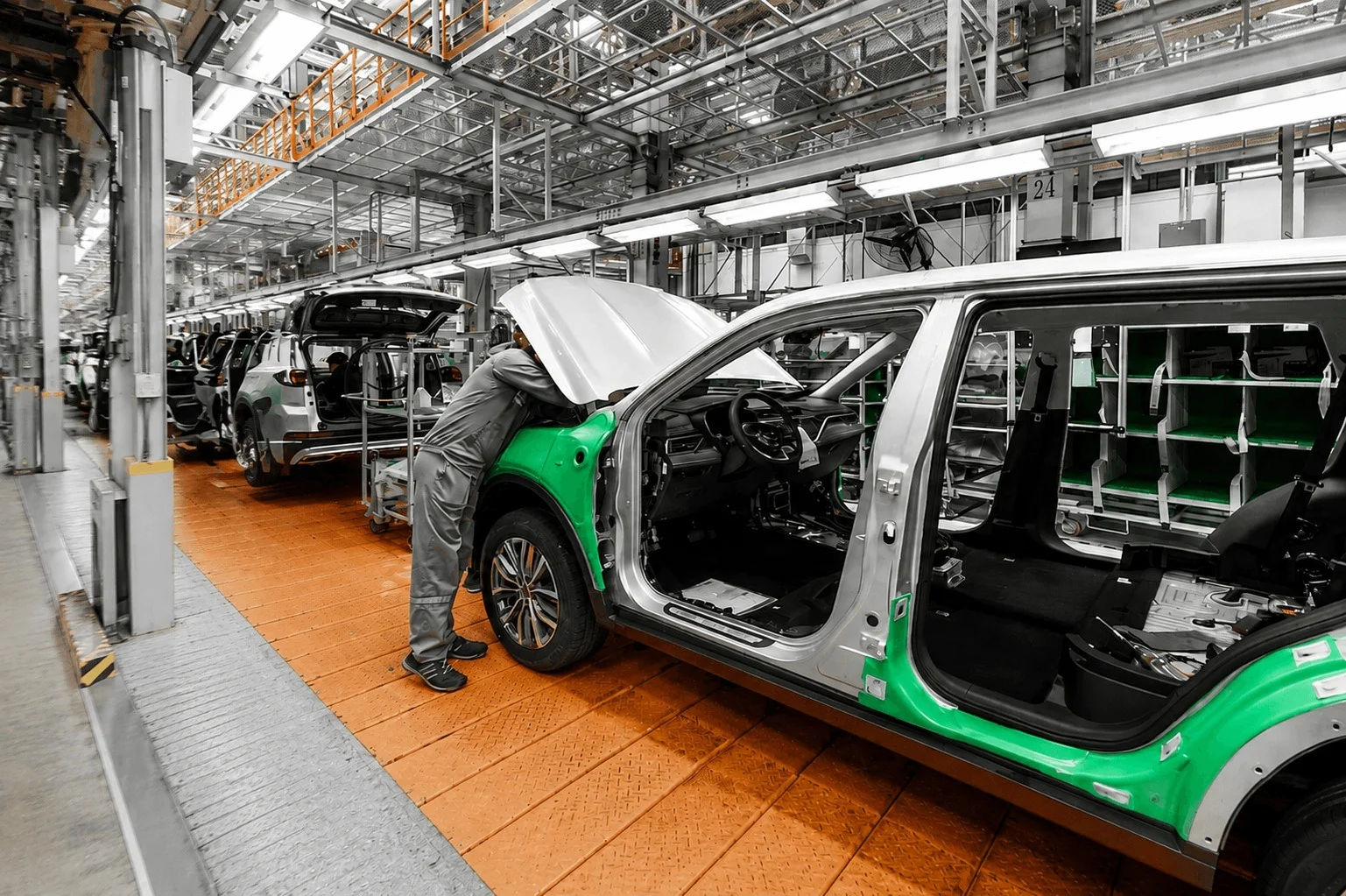
Manufacturing leaders can’t fix what they can’t see. Every stoppage, quality miss, and safety incident that goes unnoticed on the floor represents lost throughput, wasted material, or worse, a preventable injury. Production line monitoring software exists to close that visibility gap, giving plant teams a continuous, objective view of what’s actually happening on the line, rather than relying on periodic spot checks, manual logs, or after-the-fact incident reports.
Invisible AI builds computer vision-based monitoring software that turns existing camera infrastructure into a real-time source of operational intelligence. This page explains what production line monitoring software is, why manufacturers are adopting it at scale, the technology that makes it work, and how Invisible AI’s platform applies across the areas that matter most on a modern production floor.
What Is Production Line Monitoring Software, and Why Real-Time Visibility Matters
Production line monitoring software is a category of manufacturing technology that continuously observes activity on a production line, tracking metrics like cycle time, downtime, throughput, quality events, and worker safety behaviors, and turns that raw activity into structured, actionable data. Rather than depending on operators to manually log events or supervisors to walk the floor and catch issues as they happen, monitoring software captures what’s actually occurring on the line automatically, consistently, and around the clock.
Traditional approaches to floor visibility have real limitations. Manual data collection is time-consuming, inconsistent between shifts, and prone to human error or simple omission. Legacy sensor-based systems can track machine-level signals but often miss the human and process context around an event why a line stopped, what caused a quality defect, or whether a safety protocol was actually followed. Modern production line monitoring software, particularly systems built on computer vision, closes these gaps by capturing a much richer, more complete picture of line activity, without requiring new hardware to be installed at every station.
The operational value of this visibility shows up across several dimensions:
- Faster root-cause identification when a line stops or a quality issue occurs, since the actual event is captured rather than reconstructed after the fact
- More accurate downtime and cycle time data, replacing manual logs that are often approximate or incomplete
- Objective, consistent measurement across shifts, lines, and plants, enabling fair and meaningful performance comparisons
- Earlier detection of small issues before they escalate into larger production or quality problems
- A continuous feedback loop that supports ongoing operational improvement rather than periodic, disconnected audits
As manufacturers face pressure to improve efficiency, reduce waste, and maintain consistent quality across increasingly complex operations, production line monitoring software has moved from a nice-to-have analytics tool to a foundational layer of how modern plants manage performance.
The real operational shift that monitoring software enables isn’t just having more data; it’s having that data available immediately, while there’s still time to act on it. When line performance, quality events, and safety observations are captured and surfaced in real time, plant teams move from a reactive posture, where problems are discovered well after the fact, to a proactive one, where issues can be addressed as they emerge.
This shift matters for several concrete reasons. Downtime is expensive, and the longer it takes to identify why a line stopped, the more production is lost. Real-time monitoring shortens that diagnostic window dramatically, often turning a multi-hour investigation into a matter of minutes. Quality issues behave the same way: a defect caught and understood immediately can often be corrected before dozens or hundreds of additional units are affected, whereas a defect discovered during a later audit may already represent significant scrap or rework cost.
Real-time visibility also changes how teams communicate and collaborate. Supervisors, engineers, and plant managers working from the same live data source can align quickly on what’s actually happening, rather than debating whose account of an incident is most accurate. This shared, objective view reduces friction between shifts and departments and speeds up decision-making at every level of the organization.
Perhaps most importantly, real-time monitoring creates the foundation for genuine continuous improvement. Static, backward-looking reports can highlight that a problem exists, but they rarely provide enough context, fast enough, to drive meaningful process change. A continuous stream of real-time data, tied to actual video and event context, gives engineering and operations teams the evidence they need to test changes, measure impact, and refine processes on an ongoing basis, rather than relying on periodic improvement initiatives that lose momentum between reviews.
The Technology Behind Modern Production Line Monitoring Software
Invisible AI’s approach to production line monitoring software is built around computer vision using cameras already present, or newly deployed, on the production floor to automatically observe and interpret what’s happening on the line, without requiring manual data entry or extensive new sensor infrastructure.
Automated event detection: Rather than relying on operators to record every stoppage, quality issue, or safety observation, the software is trained to recognize these events directly from video, flagging them automatically as they occur and attaching relevant context, such as the exact moment and location of the event.
Human and process context, not just machine signals: Because the system observes the full line environment rather than a single machine sensor, it can capture context that purely mechanical monitoring systems miss, including operator actions, workflow deviations, and the sequence of events leading up to an issue.
Scalable deployment across lines and plants: A monitoring platform built for modern manufacturing needs to scale efficiently across many lines and multiple facilities, applying consistent detection logic and reporting standards everywhere it’s deployed, so that performance data is genuinely comparable across the organization.
Structured, searchable data output: Raw video observation is only useful if it’s translated into structured, analyzable data -downtime categorized by cause, quality events tagged by type, safety observations logged with time and location,-so that teams can query, trend, and report on the information without manually reviewing footage.
Integration into existing workflows: Effective monitoring software fits into the tools and processes plant teams already use, surfacing insights through dashboards, alerts, and reports that support existing production management and continuous improvement routines, rather than requiring an entirely new operating model.
Privacy-conscious, purpose-built design: Because this technology operates in an environment with people on the floor, responsible monitoring platforms are designed with clear boundaries around what is observed and how footage and data are used, focused specifically on operational and safety insight rather than individual employee surveillance.
This combination of automated detection, rich contextual data, and scalable deployment is what allows Invisible AI’s production line monitoring software to deliver real-time visibility that manual processes and traditional sensor systems simply can’t match.
How Invisible AI’s Platform Supports the Full Production Floor
Invisible AI’s production line monitoring software is applied across several core areas of plant operations, each addressing a different dimension of floor performance and risk.
Our safety and ergonomics capabilities use the same camera-based monitoring foundation to identify at-risk behaviors and ergonomic strain on the line, helping plant teams reduce injury risk proactively rather than relying solely on after-the-fact incident reports.
On the quality side, the platform captures defect events and process deviations as they happen, giving quality teams the visual context they need to identify root causes quickly and prevent recurring issues before they affect larger production runs.
For broader floor visibility, our production management tools bring together line performance, downtime, and throughput data into a real-time operational view that helps plant managers make faster, better-informed decisions.
That same continuous stream of operational data also feeds directly into continuous improvement initiatives, giving engineering and operations teams the objective evidence they need to test process changes and measure their impact over time.
Invisible AI’s platform is deployed across demanding manufacturing environments, including automotive production, where line speed and quality consistency are critical, and aerospace manufacturing, where precision and traceability requirements are especially stringent.
Together, these capabilities make Invisible AI’s production line monitoring software a single platform that supports safety, quality, production management, and continuous improvement across some of the most demanding manufacturing sectors in operation today.
Frequently Asked Questions: Production Line Monitoring Software
What is production line monitoring software used for? It’s used to continuously track what’s happening on a production line, including downtime, quality events, throughput, and safety behaviors automatically and in real time, replacing manual logs and periodic floor checks with consistent, objective operational data.
How is computer vision-based monitoring different from traditional sensor systems? Traditional sensors typically capture machine-level signals but miss the broader context around an event. Computer vision-based monitoring observes the full line environment, capturing operator actions and process context alongside line performance data, which makes root-cause analysis faster and more complete.
Does production line monitoring software require new hardware on the floor? Many modern platforms, including camera-based systems, are designed to work with existing camera infrastructure or straightforward camera deployment, avoiding the need for extensive new sensor installation at every station.
How does monitoring software support continuous improvement efforts? By providing a continuous, real-time stream of accurate operational data rather than periodic, backward-looking reports, monitoring software gives engineering and operations teams the evidence they need to test process changes and measure results on an ongoing basis.
Is production line monitoring software only useful for large manufacturers? No. While large, multi-plant manufacturers benefit from the ability to standardize monitoring across facilities, the same real-time visibility and faster root-cause identification benefits apply to single-site operations looking to reduce downtime and improve quality consistency.