
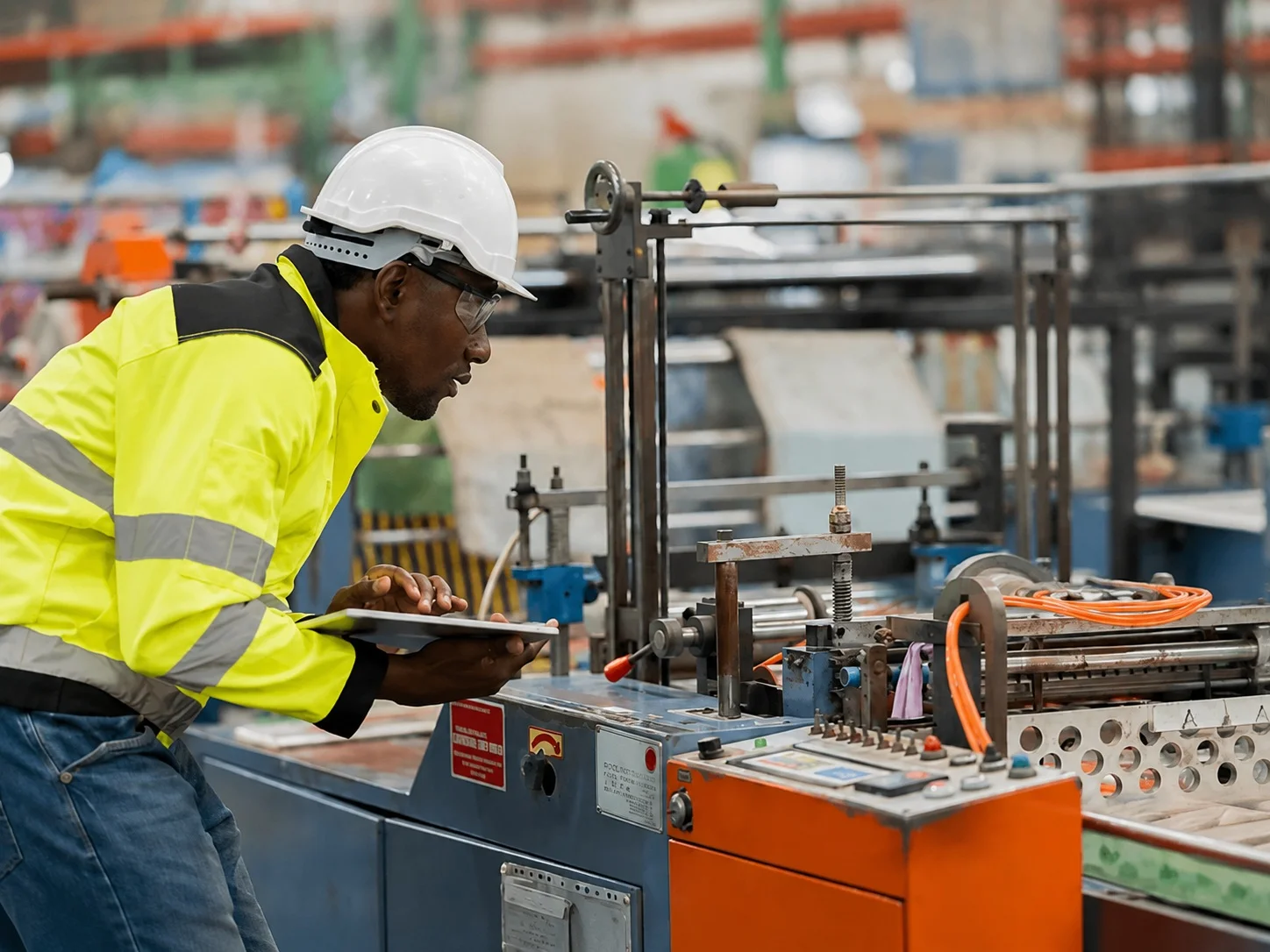
Every plant manager balances two priorities that can feel like they pull in opposite directions: hit the day’s output, and keep the people producing it safe. Musculoskeletal injuries make that balance harder than it should be. They remain among the most common and costly injuries in manufacturing, often building slowly over weeks of repeated motion rather than happening in one visible incident. Overexertion alone accounted for close to one million cases involving days away from work, restriction, or transfer in 2023 and 2024, and the National Safety Council points to musculoskeletal disorders as the most common workplace injury overall, based on Bureau of Labor Statistics data (source: National Safety Council). Ergonomics safety software gives teams a way to catch that risk while it is still just a risky motion, not yet an injury.
These injuries also carry a cost far beyond the individual case. A single musculoskeletal injury typically means lost workdays, light-duty accommodations, and the time it takes to train a replacement on a station they have never run, all while the line still has a shift to get through. Preventing that injury in the first place is almost always cheaper and far less disruptive than managing it after the fact.
This article looks at why periodic ergonomic assessments miss so much, what continuous ergonomics monitoring does differently, and what to look for when evaluating a solution for your own facility.
Why Traditional Ergonomics Assessments Fall Short
Most ergonomics programs still rely on periodic audits. A safety professional walks the floor with a checklist, scores a handful of stations, and moves on to the next area on a rotating schedule. It is a reasonable starting point, but it has real limits. An audit captures one moment on one day. It cannot see how a station’s risk changes between the morning and afternoon shift, or how a fatigued operator’s posture drifts over the last two hours of a long run.
Musculoskeletal injuries rarely come from one dramatic lift. They build from thousands of small, repeated motions over weeks or months, which is exactly the kind of pattern a periodic checklist is poorly suited to catch. By the time a spot-check flags a station as high-risk, the operators working it may have already been absorbing that strain for a long time.
There is also a consistency problem with manual scoring. Two safety professionals looking at the same motion can reasonably disagree on how risky it is, since ergonomic assessment tools rely on human judgment applied to a brief observation. That is not a criticism of the people doing the assessments. It is simply a limit of trying to score a continuous, physical process using a periodic, subjective method.
What Ergonomics Safety Software Does Differently
Ergonomics safety software replaces the periodic snapshot with continuous motion monitoring. Instead of scoring a station once a quarter, it analyzes posture, reach, and repetitive motion at every station, every cycle, automatically. That means a system can flag a high-risk pattern the same week it starts, rather than the same quarter someone happens to walk by with a clipboard.
Our Safety & Ergonomics solution is built around exactly this kind of continuous coverage. Ergonomic risk data gets pushed directly to safety teams, and team leads automatically, flagging high-risk stations before an injury happens rather than after an incident report gets filed.
This also changes the granularity of what a safety team can see. Instead of a single risk rating for an entire station, continuous monitoring can show how risk shifts over the course of a shift, whether a particular product variant introduces awkward reaching that a different variant does not, and whether a specific operator’s technique differs in a way worth coaching. That level of detail simply is not available from a quarterly checklist, no matter how carefully it is filled out.
From Reactive Safety to Proactive Risk Prevention
Most safety programs today are still structured around incident response. Something happens, a report gets filed, an investigation follows, and a corrective action gets put in place, usually after the fact. Continuous ergonomics data flips that sequence. Instead of waiting for an incident to point to a problem station, the risk score points there first.
This changes what a safety team’s day actually looks like. Rather than spending most of their time on paperwork and investigations, they can spend more of it walking toward the stations the data already flagged as elevated risk, well before those stations generate a claim. Over time, that shift from reactive to proactive is what actually lowers an injury rate, rather than just documenting it more thoroughly.
How Vision-Based Systems Keep Workers Comfortable With Monitoring
Ergonomics monitoring only works if operators are comfortable with it, and monitoring understandably raises questions the first time it gets introduced on a floor. Camera-based systems address a lot of that concern by design. They require no wearables, so there is nothing attached to the operator’s body or clothing, and no change to how the job actually gets done.
We deploy entirely on-premises, which means video and process data stay within the facility rather than routing through the cloud, a point worth raising directly with your team and covered in more detail on our Security & Privacy page. When operators understand that the system exists to catch risky patterns before they get hurt, not to police individual performance, adoption tends to go far more smoothly than teams initially expect.
How a rollout gets communicated matters just as much as the technology itself. Plants that introduce ergonomics monitoring alongside a clear explanation of what it does, who sees the data, and how it will actually be used tend to see far less resistance than plants that roll it out quietly and let operators fill in the gaps with assumptions. A brief, honest conversation up front usually prevents most of the concerns before they start.
What Good Ergonomics Software Should Deliver
If you are evaluating options, a few things separate a genuinely useful system from one that just adds another dashboard.
Full coverage: Risk data from a handful of sampled stations leaves gaps, while continuous coverage across every station and shift is what actually catches drifting risk early.
Clear, actionable scoring: Raw video with no analysis just shifts the burden back onto a safety team that is already stretched thin. Look for a system that translates motion data into a clear risk score tied to a specific station and cycle.
Fast routing: A risk flag that sits in a monthly report does not prevent much. The system should route alerts to the right person quickly enough to act on them.
Manufacturing-specific experience: General workplace wellness tools are not built around the pace and physical demands of a production line. A system built specifically for manufacturing environments tends to produce far more relevant, actionable data.
It is also worth asking how a vendor handles the transition from data to action. A risk score with no clear next step just becomes another number a safety team has to interpret on their own. The more useful systems pair the score with enough context, including video of the actual motion, for a safety professional to identify the specific fix needed, whether that is a fixture adjustment, a work instruction change, or a conversation about technique.
The Productivity Connection: Why Safety and Efficiency Are Not Competing Goals
It is easy to treat safety investment and production targets as a trade-off, but the two are more connected than they first appear. Injuries drive absenteeism, turnover, and the cost of training a replacement worker on a station they have never run before, all of which hit output just as hard as a mechanical breakdown does. An ergonomically risky station is also frequently a station with a process problem, whether that is an awkward part orientation, poor fixture placement, or a layout that forces unnecessary reaching. Fixing the ergonomic risk often fixes the efficiency issue at the same time.
Customers using our platform have found new use cases for this connection beyond the original safety goal. One advanced technology engineer at an automotive OEM described ergonomics analysis as one of the ways their team is now proactively preventing injuries while continuing to find broader process improvements on the line. You can read more results like this in our Case Studies.
There is also a retention argument worth making to leadership directly. Operators tend to stay longer at stations that do not wear their bodies down, and word travels fast on a shop floor about which lines are hard on the body and which are not. A visible, active ergonomics program is not just a safety initiative. It is part of what makes a facility a place people want to keep working.
Conclusion
Protecting workers and hitting production targets were never actually in competition. What made them feel that way was a lack of visibility into ergonomic risk until it had already become an injury. Continuous ergonomics monitoring closes that gap, giving safety teams and team leads the chance to act on a risky motion pattern while it is still just a pattern.
Our platform, Invisible AI, pushes that risk data automatically to the people who can act on it, station by station and shift by shift. If you would like to see how it works on your own floor, book a demo with our team.